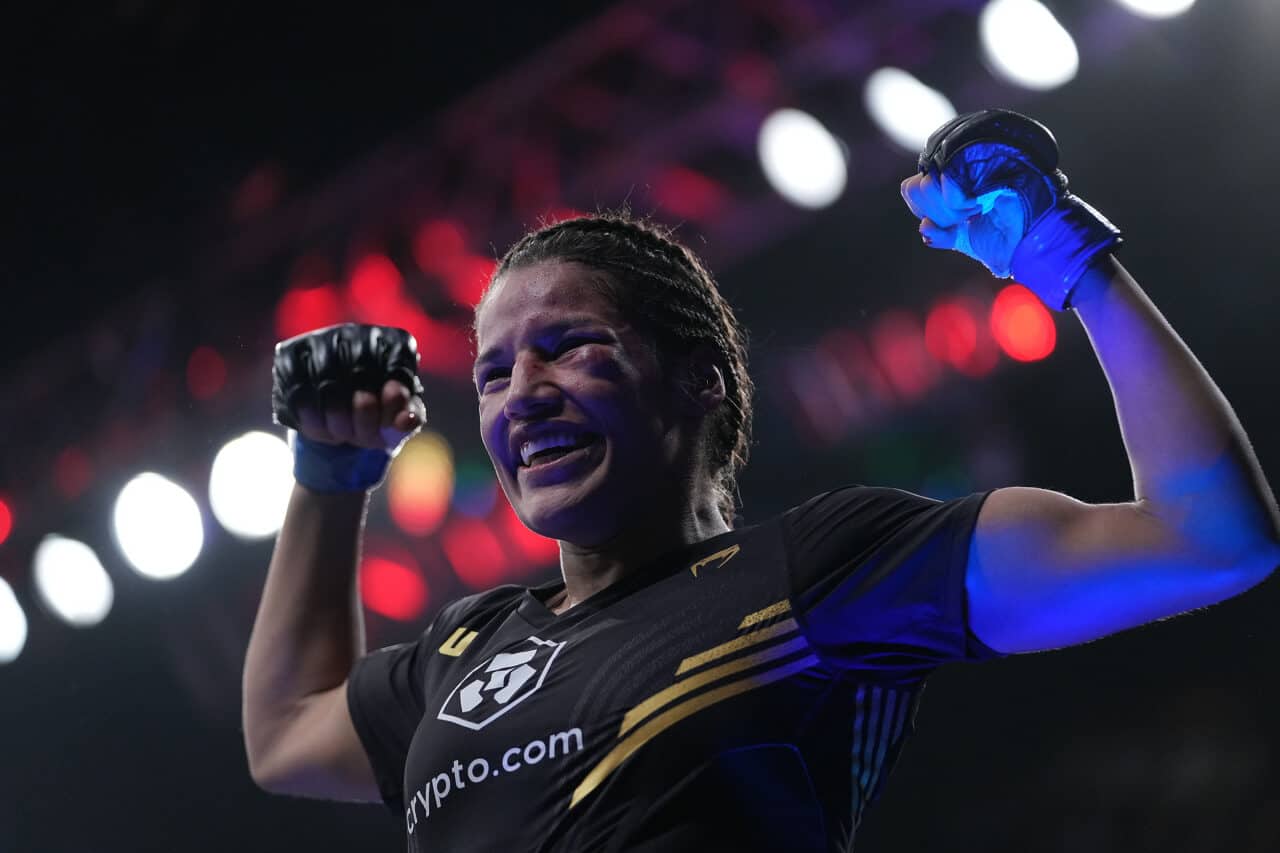
Few discursive avenues in sports are less serious than armchair psychology in both pre-competition prognostication and post-mortem debriefing. Last Saturday’s UFC 269 bantamweight world title fight between defending champ Amanda Nunes and challenger Julianna Peña offers a good case in point.
Leading up to their bout, it was all the rage on social media for observers and commentators to show photo comparisons of Nunes and Peña from last week to supposedly demonstrate how scared and lacking in confidence Peña was, (just look at her face!) and how assured Nunes was (just look at her face!).
It was an easy narrative to pick up. After all, Peña headed into the showdown with only a one-fight win streak and having lost two out of her last four contests. Nunes, on the other hand, was the reigning two-division world champ (bantamweight and featherweight) and had won 12-straight, with six of those victories coming over former and current champions.
Don’t buy into armchair pre-fight prognostication
Nunes was, quite simply, the most dominant fighter in MMA for the past half-decade. There was nothing wrong with assuming she’d beat Peña (I did), but pretending to come to that conclusion because of feigned insight into either athletes’ mind was, as it almost always is, absurd.
The joke was that, for all her bluster, Peña looked like she didn’t really want to be there last week. After she shocked the world and submitted Nunes to become the new UFC bantamweight champion, however, it did not take long for the same type of unqualified pundit to say that Nunes looked like she didn’t want to be in there, or looked relieved to lose, or other things to that effect.
Those quick takes are just as silly as the pre-fight ones that claimed to understand that Peña wasn’t mentally up to the task of facing Nunes. It’s easy to explain away how wrong one’s pre-fight prediction that the juggernaut would simply continue to dominate was, by saying well, the champ must have been mentally broken.
It’s an easy resolution for pundits, amateur and professional alike, who have never fought or coached, but it is without much evidence. Of course, Nunes looked different or off after losing, after having her brain knocked around a bit in the second round. She looked plenty happy to be in the bout in the first round, though. Let’s refresh our collective memory.
It’s hard to be an expert on the fight game with no fights
Did Nunes look like she didn’t want to be there when she knocked Peña to the ground with the first strike she landed – a calf kick? Did Nunes’ face betray inner turmoil when she dropped Peña to the canvas again, moments later, after landing a right punch?
How about when Nunes rag-dolled Peña in the clinch and on the ground during the first round, literally smiling throughout and drawing a big reaction for it from the arena crowd? No, Nunes looked like Nunes — calm, content, effective, as she immediately hurt and dominated Peña in the first round. What ended up being different, then?
Well, there’s no need to jump to pseudo-science. The fight unfolded in a way that logically led to Nunes being dethroned. Peña’s own mental fortitude, conditioning, and skill won out. Take nothing away from Nunes, this is why they fight the fights, after all.
This particular opponent when Pena just happened to be able to take the beating from Nunes in the first and then come out in the second and immediately land a couple of damaging punches of her own that rattled Nunes in the second round, turning the tide of the fight in her favor. Don’t ever let people who have never been in that situation — fighting after getting their brain rattled — lecture you on what to be expected from fighters when that happens to them.
Technically, Julianna Pena did the right things needed to win
From a technical standpoint, Peña took advantage of holes in Nunes that were always there. Peña didn’t make Nunes break mentally, or at least I should say that there is no evidence of that. Peña had the rare confidence to stand and strike with Nunes, the rare chin to withstand the initial beating she took as a reward, and (unlike Germaine de Randamie, who also had those abilities) has amazing jiu-jitsu skill on the ground, especially on top, to go with above-average takedown ability.
Nunes was never going to do well if she ended up on the bottom with lots of time left against someone as good on top as a Peña or a Cat Zingano. The question of Nunes vs. Peña was always going to be whether Peña could take a beating but still then land enough of her own strikes to damage Nunes and make takedowns possible.
Peña answered that question. Her jab was straight, quick, and stunning, and her overhand right was awkward in the perfect way to take advantage of the space Nunes leaves in her guard on the feet. Once Nunes was hurt, her guard got wider, letting in more punches from Peña, and her own attacks predictably slowed. When brain damage is sustained, it doesn’t typically make one more quick-acting or wise.
Pena sent Amanda Nunes into default mode at UFC 269

Fighters fall back to their default mode when hurt or stressed. If they’re an aggressive knockout artist like Nunes, ‘Cyborg’ Justino, or Wanderlei Silva, hurt sluggers usually devolve to their original wild selves, no matter how much training they’d done in recent years to refine their strikes and tame their aggression.
Nunes was able to bring this out in Justino when they fought. If a fighter’s default mode happens to fit the tactical need of the moment, and they are supremely conditioned, it’s possible to see greats respond to brain damage with effective fighting. Charles Oliveira himself showed this once again later Saturday night. After being dropped by Dustin Poirier, Do Bronx still won, but his victory certainly came after he reverted to his strengths — long punches, bodywork in the clinch, and an urgency to get to grappling scenarios where his stellar Jiu-Jitsu could finish.
Peña’s own self-belief does not imply a lack of it from Nunes. Peña is uncommonly gritty and resilient, and that gave her opportunities to demonstrate technical superiority in the moments and spots she needed to. She didn’t wilt after being hurt, didn’t get desperate for takedowns, but instead stayed in the pocket to give herself a chance to hurt Nunes. Once that happened to work out for her, Peña landed a smooth takedown and got to work on top.
From there, her choke technique was textbook perfect. By the time Peña got to Nunes’ side, the challenger had already slid her primary choking hand underneath Nunes’ chin. After that, Peña worked behind Nunes, stayed low on the champ’s hips, and stayed lethally connected to her back by pinching her knees and covering the entire back with her chest. The secondary hand connecting to the primary strangling one was almost a formality at that point, resulting in a prompt tap out from Nunes.
Nunes wasn’t mentally broken, just outworked by a tough and skilled fighter
People without an understanding of strangles/chokes from these positions will talk about insignificant matters like Peña not having her feet, or hooks, tucked inside of Nunes’ inner thighs, and then express wonderment at how the finish still happened. The reality is that Peña had the choke in completely.
Some fighters resist in futility in these scenarios until they’re unconscious, and others recognize the situation and decide to tap out and minimize damage. Choosing the latter course isn’t, in and of itself, evidence of a fighter having been broken mentally. Nunes was surely thrown for a loop both physically and mentally when a fight she was dominating turned on a dime and she started getting rocked, but that’s different than some broad notion that she wasn’t ready to fight on Saturday.
Getting one’s brain rattled will have a profound effect on one’s balance, timing, speed, awareness, and a host of other crucial factors. Peña’s damaging punches to Nunes were exactly the shots Nunes theoretically gives all opponents (straight down the middle or over the top of her wide guard), but most opponents don’t stick around long enough to land them, or if they do, don’t make her work in the clinch and on the ground as much as the Peñas, Zinganos, or an Alexis Davis of the world.
Whenever someone threatening on the ground has lasted long enough on the feet against Nunes to give themselves a chance to continue working, she’s lost. It just so happens that Nunes is great at keeping things away from unfavorable positions for herself, so she’s rarely faced such circumstances.
Fighting is unpredictable, and even the greats lose. What’s more, they can lose without suddenly having been broken mentally. By all appearances, that’s what happened on Saturday night. Credit should be given to Peña, and no real debasing of Nunes’ own abilities or mindset needs to be done. Both women are, after all, champions both figuratively and literally. One champ walked in the cage, but two left it.